
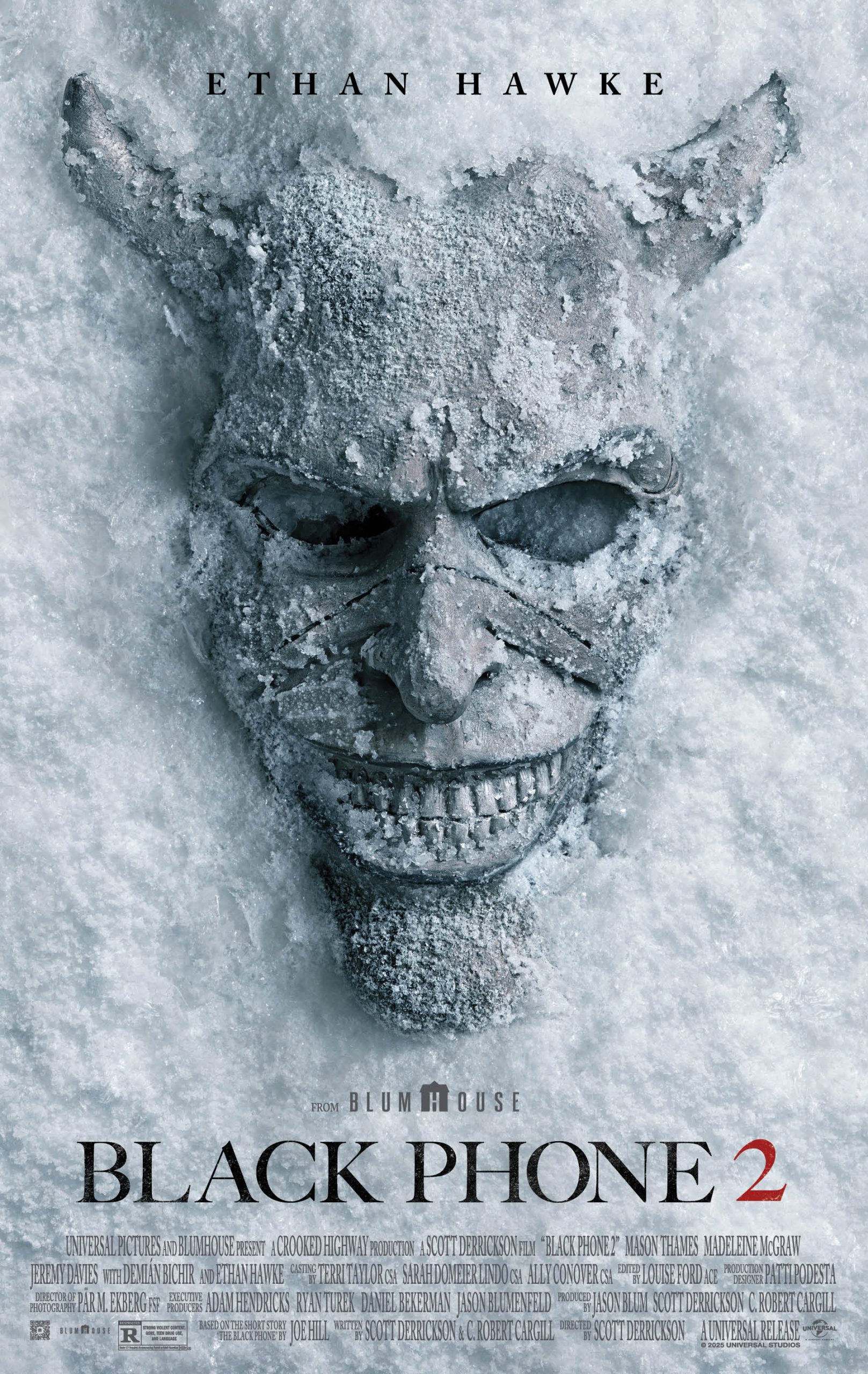
 It is entirely possible that my expectations for Black Phone 2—a sequel with the cast, co-writing team, and director returning from the first—were too high. The Black Phone excelled at finding a balance between the frightful and the emotional, and I was hoping for more of it. Like its predecessor, Black Phone 2 (there’s no The on the title screen) takes its premise and barrels with a laser focus toward its goal, but I feel like something’s shifted in the transition from being based on a Joe Hill story to being a fully standalone tale. For better or worse, I don’t know; this review is helping me figure that out.
Let me say first that I love that director/co-writer Scott Derrickson and co-writer C. Robert Cargill share an obvious love for horror. They know precisely how to freak us out and when to do it, and they bring all their skills to make sure the film’s main character pivot from Finney Blake (Mason Thames) to Gwen Blake (Madeleine McGraw) sticks. In the film’s world (and in real life), four years have passed since we met these siblings and The Grabber (Ethan Hawke), the man who kidnapped Finney with the intent to murder him. But after Finney turned the tables on him with some supernatural help from the ghosts of The Grabber’s victims and Gwen’s own nascent psychic abilities, life’s been… interesting.
 For starters, their father, Terrence (Jeremy Davies), got sober and less mean. Conversely and unfortunately, Finney’s gotten meaner and started smoking weed, both of which are the result of his ordeal four years earlier. Kids at his high school hear about the legend and want to test Finney’s toughness, so they take a shot at the title, only to wind up on the ground, bloodied and bruised, as we see in the film’s post-prologue reintroduction to the Blake family. The cannabis has more to do with how noisy his mind is now, being able to hear ringing phones that shouldn’t be ringing and people on the other end of those lines that shouldn’t be there. He’s sliding into the darkness headfirst, and his demeanor—even with Gwen—is indicative of someone in more trouble than he thinks he’s in, someone who’s accepting his “new normal” all too quickly without properly confronting what’s happened.
Gwen seems to have gotten more of her share of their late mother Hope’s (Anna Lore) parapsychological abilities, and—similar to Finney—it’s something she’s having trouble dealing with. It’s an almost puberty-like onset, where the visions she receives in her dreams get bigger and bigger until she’s sleepwalking all the way to The Grabber’s now-empty house and seeing portents of his return. She’s alienated at school, written off as the local kook; the local mean girls are portrayed as having a penchant for teasing her regularly, and no one’s willing to listen, not even Finney. Well, sorta—there’s Ernie (Miguel Mora), whose older brother Robin was The Grabber’s last victim before Finney found his way into that basement. Mora played Robin in the first film, and it’s interesting to see how a single actor does this kind of double duty, playing one character dealing with their own demise and then playing his brother, who’s doing the same. (Honestly… it’s fascinating.)
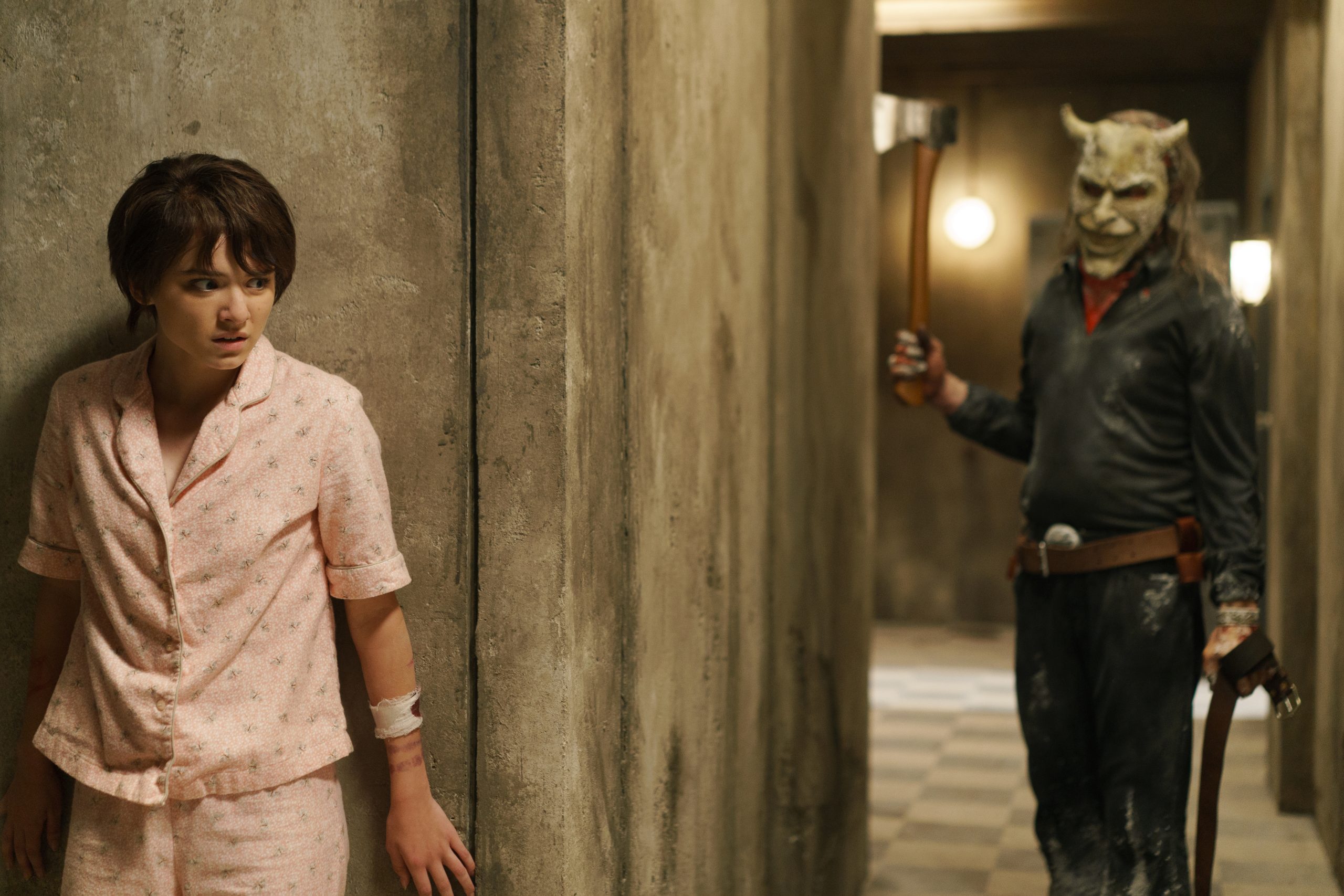 Black Phone 2 asks both Gwen and Finney to face their issues head-on, which is how this movie brilliantly weaves in its main plot concerning three missing children. However, they’re not Gwen or Finney’s contemporaries; they disappeared from a Colorado mountain camp that Hope attended in 1958. It’s a Christian camp that closed after these disappearances; now, in the 1980s, it’s been renovated and is ready to open again, with pamphlets advertising open counselor positions. Along with Ernie, Gwen and Finney go to do their own investigation amid a raging blizzard, spurred on by a cross-decades phone call that kicks this whole movie off.
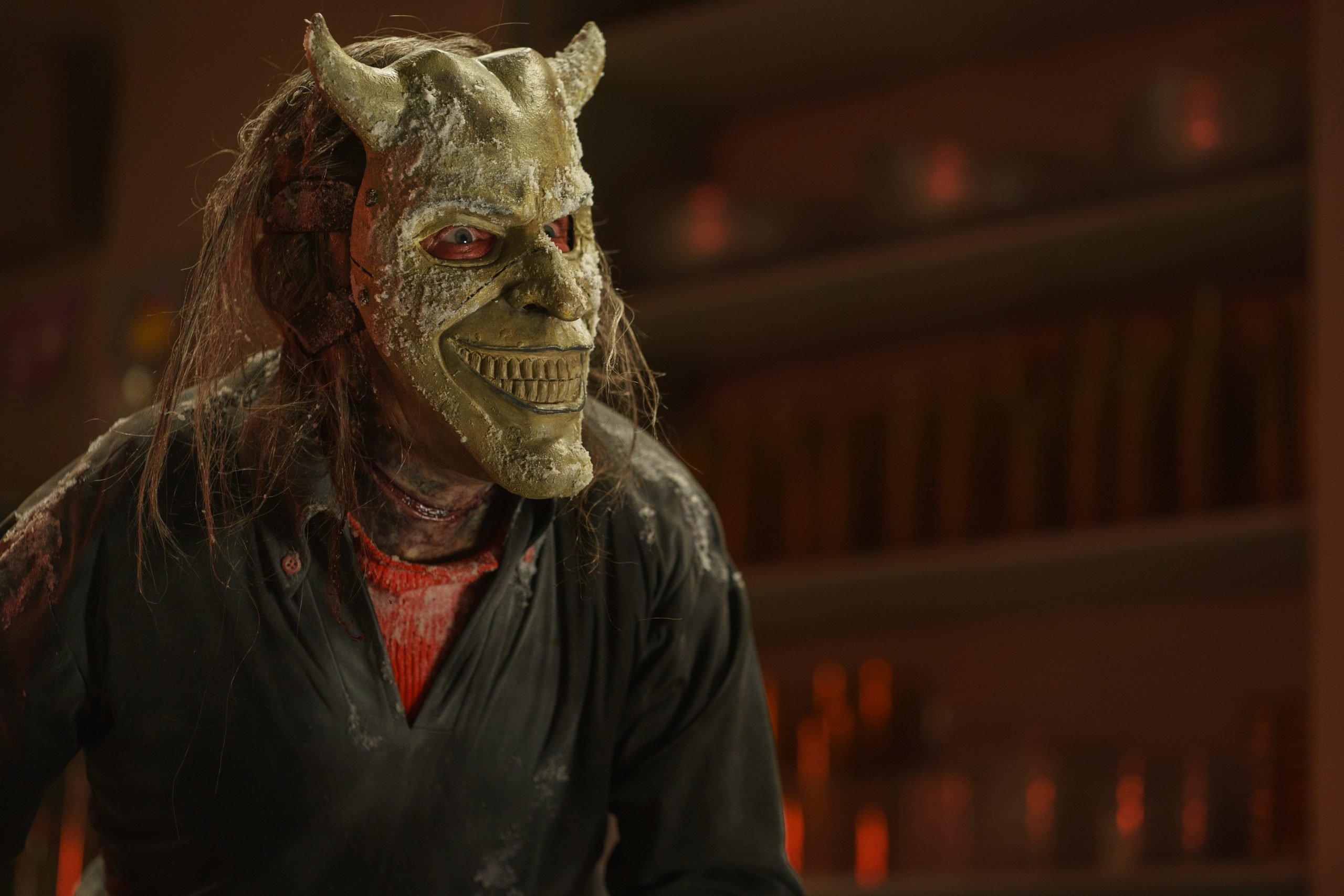
Derrickson and Cargill’s script puts Gwen front and center to explore the growing danger The Grabber poses as a malevolent spirit. While he toys with Finney and distracts him with phone calls (there’s a phone booth by the lake near the camp’s cabins), it’s Gwen whom The Grabber truly wants—not only because she helped find The Grabber’s buried victims, but because he aims to hurt Finney by taking away what he loves. Even with his limited screen time, Ethan Hawke once again terrifies us as The Grabber, who’s now more of a demonic presence in death than he was in life. He only wears one mask, which hides the abject evil he has become; as parts of his mask are removed, we see just how much of his soul is reflected in what’s left of his body, and what he’s got planned for Gwen and Finney is only a fraction of the horror being unleashed.
 Several throwbacks to ‘80s slasher films are included, and they become both familiar and new territory in Derrickson and Cargill’s hands. A key sequence from 1983’s underappreciated Curtains gets a little nod, which fans will, no doubt, recognize and enjoy. Also referenced is a certain film franchise featuring a lakeside camp closed in 1958 and reopened in the ‘80s, and the killer wears a mask… yeah, I know, right? But nothing could top a later development in the film where wounds inflicted on one’s body in the dream world manifest physically in the real world, with damage from an invisible blade bloodying up a victim with no rhyme or reason to the observer. In more ways than this, The Black Phone and Black Phone 2 echo the history of A Nightmare on Elm Street‘s Freddy Krueger, a child murderer who grew stronger as a dream murderer after vigilante justice was wrought upon him. Of course, being stuck in a blizzard at a remote location harks back to one of the granddaddies of ’80s horror films, The Shining, and Stephen King gets another nod to his teleplay for his Tales From the Darkside episode “Sorry, Right Number” with the time-jumping phone call.
(Note: In an exchange on Bluesky, C. Robert Cargill told me he’s never heard of “Sorry, Right Number”—the similarities in plot were coincidental.)
Madeleine McGraw takes the lead well in Black Phone 2, etching a vulnerable yet powerful figure with Gwen. She’s not the shriek-and-cower slasher film type; she takes charge and runs as much as possible with it, becoming a leader to both the kids and the adults caught at the camp with them in the blizzard. The adults might hold the seniority because of their age, but she soon proves that she holds the authority. Gwen is a fascinating horror film denizen, being pulled in several different directions—her psychic connection to her mother and the events of the camp, a friendship with Ernie that might be growing into something else, needing her brother and having to defend him, and just being a kid—but she manages it with toughness and spark, and McGraw makes her believable and worth watching.
 Meanwhile, Mason Thames captures Finney in the throes of teenagerdom amid brutal circumstances. What’s happened to him has caused him some estrangement from his peers, who once looked at him like a hero; now, he’s the weirdo who walks home by himself and doesn’t have any friends. He can rely on his sister, but even she’s got some strange things going on, and he’s had to wake her up from these alarming dreams. The last four years have brought consequences to his door, but instead of asking for help, he’s turned inward, preferring to deal with it on his own, and Thames plays Finney’s angry solitude well.
These are two teens with serious post-traumatic stress, barely hanging onto each other as life rafts. Each of them still has to put up with the fallout from the events of the first film, and Black Phone 2 largely keeps this fight in the forefront. Derrickson and Cargill’s script connects the past with the present via Gwen’s psychic abilities, but the leap from the inciting incident—a very long-distance phone call—to diving into action in the present day felt a bit underdeveloped. We go from bad dreams to sleepwalking to phone calls to “Holy crap, we’re at the camp!” at breakneck speed, like Derrickson and Cargill needed to get us there as soon as possible. The reason for them being at the camp isn’t fully known until they’re there, and that’s where I get a little hazy when trying to remember how we got from point A to point B and beyond.
 Up to their arrival at the camp, the film feels a bit rushed, but once we’re there, isolated from the world (much like Finney was in The Grabber’s basement in the first film) with no one coming to help, the ball gets rolling steadily and heavily. The adults stranded with them aren’t much good, except for Mando (Demián Bichir), former camp counselor and current camp director; he knows enough to know that Gwen should be listened to, not ignored. And oh, boy, Scott Derrickson and C. Robert Cargill have cooked up some gruesome and effective frights for us when nighttime comes. Their relentless layering of tension boots Black Phone 2 into overdrive for much of the latter 2/3rds of the movie, where secrets are laid bare and long-withheld truths are exposed. It might not be as emotionally resonant than The Black Phone, and some heart-tugging moments might not land as well, but the emotion that remains adds good depth to this smorgasbord of suspense and terror.
