
Most post-apocalyptic movies feature some sort of zombie outbreak, or at least a good car chase (as in the case of this year’s nonstop “Mad Max: Fury Road”). “Z for Zachariah” has neither, unless discovering how to manually pump fuel in order to resurrect the family tractor somehow counts as the latter. But it’s with good cause, because the film focuses instead on the dynamic between three survivors in the wake of a vaguely nuclear event that has pretty much sent the human race back to the drawing board. Staged in a lush valley town that may or may not be the last livable spot on Earth, “Zachariah” opens with Ann (Margot Robbie at her best), the only remaining soul in this once bustling little enclave, conducting her daily routine with dog in tow, only to spot drifter Loomis 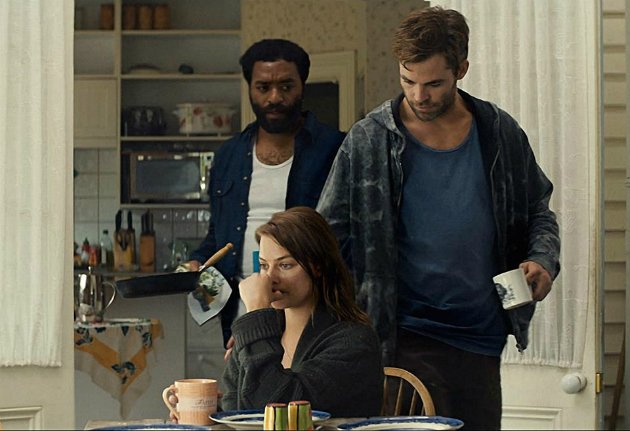 (Chiwetel Ejiofor), who arrives decked out in full radiation gear. After Ann saves him from bathing in contaminated waters, she brings him back to her farm to nurse him to health. Turns out that Loomis is a scientist with invaluable survival skills and a mysterious past.
A courtship develops over a number of months, as Loomis plans to restore power by building a hydroelectric wheel at the nearby waterfall. The relationship is made believable by Ejiofor and Robbie, and given ample substance by screenwriter Nassar Modi, who’s made significant changes to the Robert C. O’Brien novel. One such difference is the introduction of Caleb (Chris Pine), a worse-for-wear character with questionable intentions and an eye for Ann. Director Craig Zobel, whose inexplicably lauded “Compliance” was an endurance test of stupidity and perversion, shifts focus to subtle behaviors and the passive aggression often spawned by jealousy, but also explores our capacity for compassion in the face of adversity. As the flip side of something like the horror film “The Divide”, in which a group of people eventually begin to rip each other to shreds out of desperation and insanity, Zobel’s film unfolds as an elegant, existential character study that could just as easily have taken place at the dawn of civilization as after its demise.
It’s in this latter-day Garden of Eden that the fate of man potentially lies, if only human nature would get the hell out of the way. You can feel the desire to good in Ejiofor’s brilliant Loomis, particularly when opting to take things slow with a willing Ann, and even when he feels threatened by the new handsome guy in town. But there’s a dark side emerging in Loomis, something we can sense just on the fringes of the character’s intellectualism; a few stories shared over a meal just after Caleb’s arrival reveal either a harsh history or a propensity for manipulation, since Loomis is less eager than Ann is to welcome Caleb into their little oasis. When he eventually warms up to the idea of having an extra hand around, things begin to get complicated, and Ann finds her faith being eclipsed by instinct. The three actors are fantastic together, creating an uncomfortably restrained energy with one another as the tension quietly mounts, until we finally find ourselves in the middle of a psychological thriller in which egos drive the story toward a somewhat biblical conclusion.
