
Previous adaptations of William Shakespeare’s Hamlet have mostly followed the same track, with star-studded and sprawling casts, sumptuous settings and costumes, and a wide playing field upon which everyone gets to tread. From era-appropriate staging to fitting this tale into the modern day, Hamlet has had a spectacular life on the silver screen. Now comes director Aneil Karia’s adaptation of this 400-year-old play, blessed with a driving energy by Michael Lesslie’s script and fulfilled with blazing ingenuity by its lead, Riz Ahmed.
We all know the story, hopefully. At its very core, Danish prince Hamlet is tasked by his father’s ghost to avenge his murder at the hands of his brother, Claudius. While Shakespeare’s poetry and characterizations flesh out the interactions Hamlet must endure to suss out what’s happened, the play tends to feel overcrowded at times. Lesslie’s script spins Danish royalty to a wealthy, elite Indian family based in London (it’s not clear how they’ve made their fortune, but it’s implied to be in construction or real estate), which adds a layer of interesting family dynamics to this already tense story. He also pares it down to the essentials: Hamlet (Ahmed), Claudius (Art Malik), Gertrude (Sheeba Chaddha), Ophelia (Morfydd Clark), Laertes (Joe Alwyn), Polonius (Timothy Spall, who was also in Kenneth Branagh’s 1996 adaptation), Hamlet’s father (Avijit Dutt), and four other speaking roles. Most importantly, Lesslie cuts anything—scenes, dialogue, references—not germane to these characters, whittling them down to their very basic functions in Hamlet’s life.
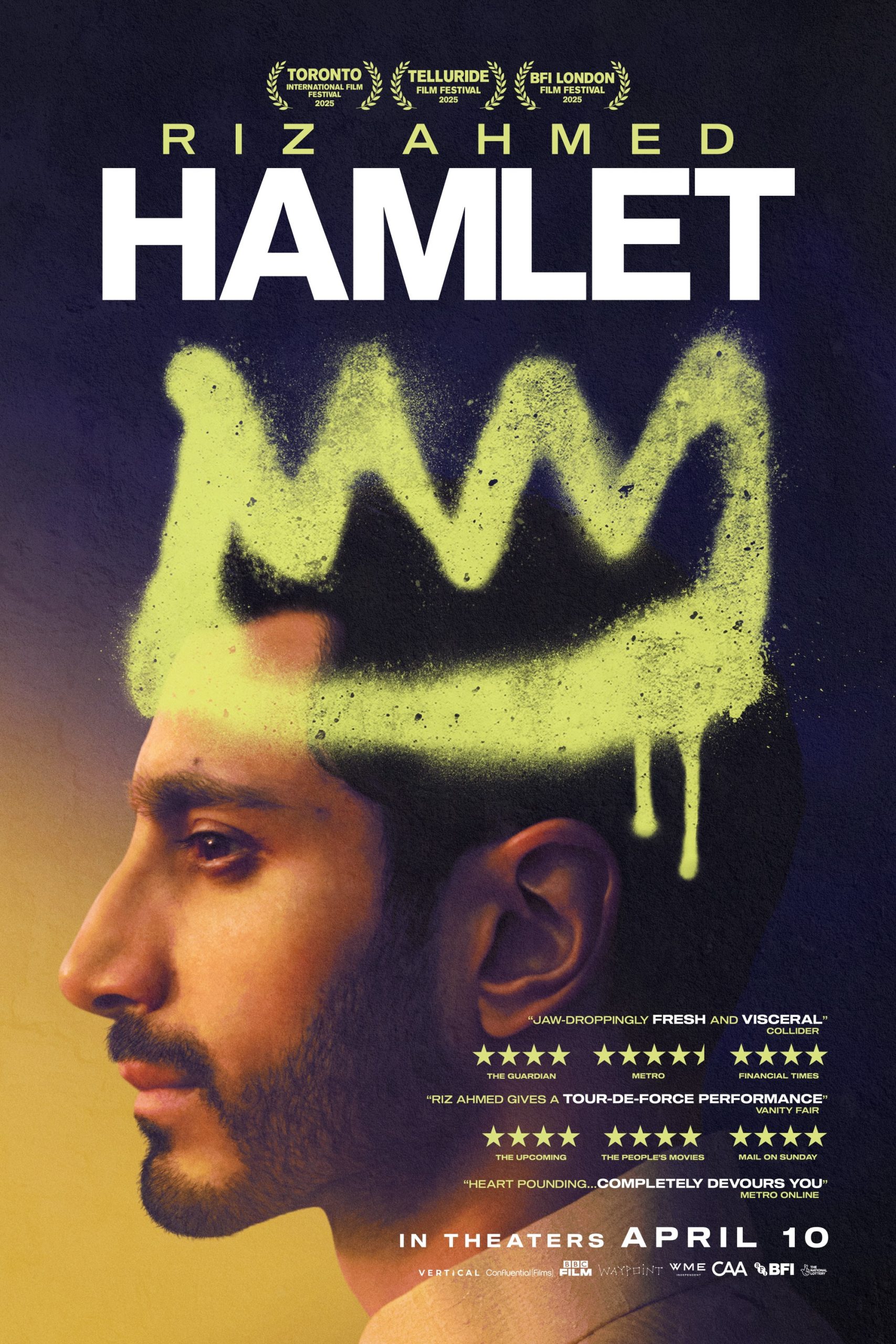 What emerges from all of this is a singular, truly dramatic vision of Hamlet, completely isolated and estranged from his friends and family as he appears to descend into madness. No buddies or betrayers, like Horatio, Rosencrantz, or Guildenstern; no mention of Yorick and how Hamlet knew him; no moments of respite with Ophelia. Lesslie wants us to feel like it’s the world versus Hamlet, and every choice Karia makes serves that sole purpose. Even with these omissions, Lesslie’s respect and love for Shakespeare’s original play is never in doubt; every cut or conflation he’s made goes further in pushing Hamlet’s back to the wall, which Riz Ahmed plays with utter passion.
Due to Lesslie’s revisions, this version of Hamlet fairly demands that its titular character be in every scene, and Ahmed is more than up to the task. He firmly holds down his end of the film, alternating confusion, seclusion, madness, sorrow, and fury with striking poise and clarity. There is never a question as to whether he can carry this film on his shoulders, as he demonstrates his innate ability to grab us with a sly, understated intensity. While he is aided and abetted by those who swirl around him and force themselves into his path of vengeance, he guts through each scene with quiet temerity and an observant, pensive countenance that speaks so much of his internal struggle without having to say a word.
Of course, when he delivers his monologues and asides, we’re fully immersed by the wise choice editors Mikkel E.G. Nielsen and Amanda James have made to give us entire, unbroken takes of Hamlet discussing his movements and thoughts with himself. Nielsen and James allow us the space to be in each scene with lengthy looks at cinematographer Stuart Bentley’s subjects, giving the film an almost stage-like feel. You can feel the weight in each edit, as if this editing team agonized over each decision to cut to another angle. Bentley’s lens choices put Hamlet front and center while turning everyone else into a blur in the background, adding another layer of isolation to Hamlet’s actions. His eye-level photography puts us within reach of these characters, and we don’t dare to lose contact with them. This tangibility gives Nielsen and James an incentive to be deliberate in their edits, shifting our vantage points only when absolutely necessary and resorting to fast cuts to disorient us during a dance performance that draws more out of its intended audience than it should have.
Aneil Karia and Michael Lesslie put a fantastic spin on this centuries-old tale, which now positively rips in a way that I’ve never seen before. The liberties taken by Lesslie do not require straying from the intent or spirit of the original; instead, they unearth a fresh, frantic perspective waiting to be taken out of the shadows and brought forward. A carefully chosen and capable cast and crew have asked us to shed what we know about Hamlet and look at the play with new eyes, and they’ve earned the right to have their request granted. This new version of Hamlet is a wonder, made with modern sensibilities that only give the original text more urgency and power.
