
 You may have heard of the Japanese light novel (their term for young adult fiction) All You Need Is Kill before, as it formed the basis of Doug Liman’s brilliant 2014 sci-fi classic, Edge of Tomorrow, starring Tom Cruise and Emily Blunt. The original All You Need Is Kill novel followed a soldier named Keiji who, during battle, dies while absorbing alien blood that imparts a strange time-looping ability to him. It’s an ability he uses to continue to fight the war to reclaim Earth; he suffers dozens of deaths, retaining knowledge from each loop and using it to adapt his movements and tactics as a new loop begins. Another soldier, Rita, has also gained this ability and used it to her advantage in combat, and together, they go through loop after loop to end this invasion. Edge of Tomorrow kept the genders and roles of Keiji and Rita from the novel while playing fast and loose with author Hiroshi Sakurazaka’s plot and themes.
In this fresh adaptation of All You Need Is Kill, director Kenichiro Akimoto reverses the focus, making Rita (Ai Mikami) our lead character and putting Keiji (Natsuki Hanae) in the secondary position. Likewise, he changes their occupations from soldiers to municipal workers assigned to clean up “Darol,” the name they’ve given to an alien plant that inexplicably landed on Earth and spread its branches all over the globe. This change by screenwriter Yûichirô Kido gives us more of a tangible hold on each character, carving a new underdog path for these relative youngsters (they don’t appear to be more than 25 years old) to learn about their time loops, improve their weapons and armor, and maybe get to know each other beyond being two people caught in the same predicament.
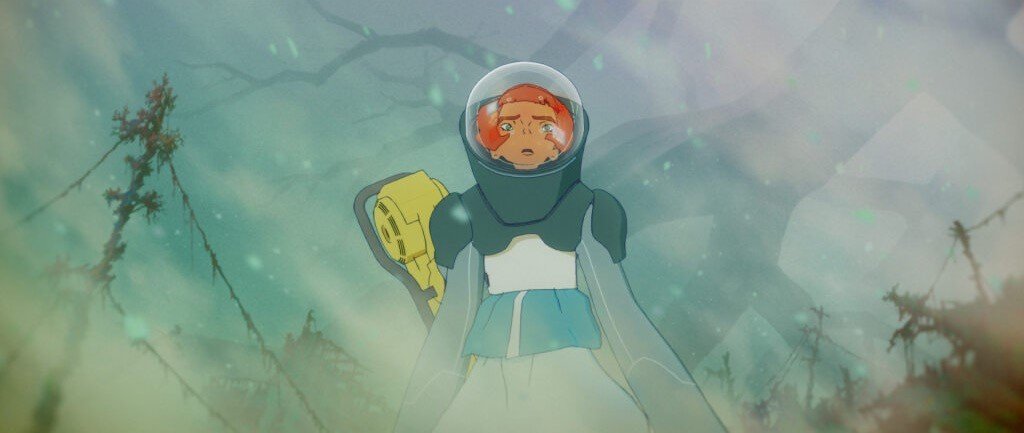 Akimoto and Kido have fashioned Rita as a sullen youth who doesn’t have any common ground with her peers; she’d rather listen to her portable CD player than entertain any of their banter. Childhood trauma has given her a brooding, pessimistic outlook, assuming the worst of her annoying co-workers and keeping to herself. Ai Mikami voices her with appropriate displeasure and aloofness, allowing very little to slip past her guard (which the vibrant animation matches). She’s a tough nut to crack; she won’t talk with people genuinely trying to befriend her, nor will she even figuratively let co-looper Keiji within arm’s reach. When she wakes up after the first loop and tries to warn her co-workers, they laugh at her and dismiss her immediately, which furthers her distrust; thus, it’s no surprise when she catches Keiji—a person she’s never met either before or after the loops started—spying on her with company tech.
In a huge contrast to Rita’s surly persona, Keiji is a bright spot amid the constantly oncoming darkness, nervously laughing off his troubles and constantly hoping for the best. Natsuki Hanae provides the film’s optimism and light through Keiji, a boy who’s had similar trouble in his past, though not quite to the extent of Rita’s trauma. They’re both damaged souls who complement each other—Keiji masterfully handles the tech aspect of their battles while Rita turns her dark past into fighting power against the aliens that have spawned out of Darol and torn through the local populace. He’s a little bit silly, and she’s a lot grouchy, but somehow, their personalities and abilities are a perfect match.
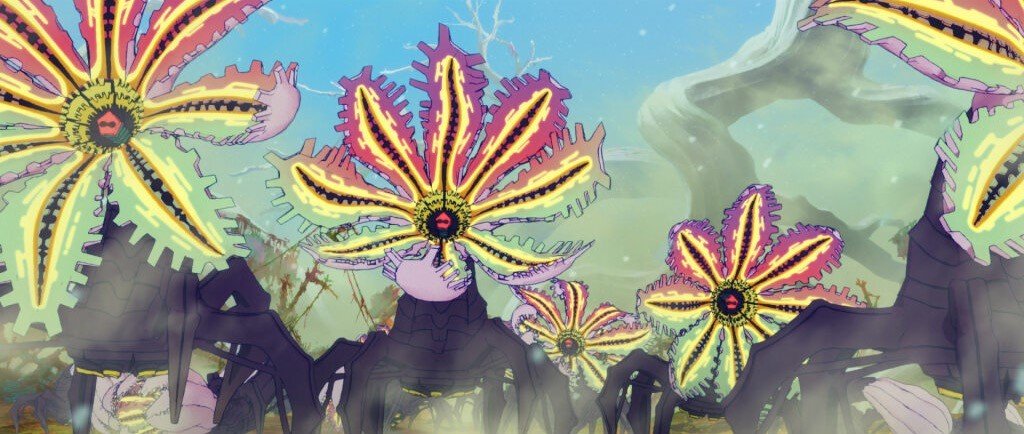 All You Need Is Kill is a universally appealing story, being about the strength of humanity in the face of certain death. The hand-drawn animation of this story lends a surreal, almost dream-like space in which these events are staged, from Darol’s tall plant structure to the buildings in which Rita and Keiji are housed and the plant-dominated surroundings where they face off against these aliens, who look like a mix of vegetation and a Demogorgon from Stranger Things. While the animation is immersive and full of wonder, it’s more the vibe and feeling of isolation in a crowded area that Akimoto wants to get across, and they get it absolutely right. Both action and quieter scenes are full of intent and purpose, and Akimoto handily allows us to appreciate what both have to offer.
I’ve been waiting for this adaptation of All You Need Is Kill, and my expectations were met and—especially with the changes from the source novel—exceeded. All You Need Is Kill is entirely its own thing, unhindered by nods to Edge of Tomorrow, and it invites us right from the beginning to jump into its world and run alongside our leads. Colorful, engaging animation and just-right voice performances are what grab us, but it’s the characterizations and the personal attachments that elevate this film into excellence. Yûichirô Kido’s script is magnetic, drawing us gently into Rita’s sphere along with Keiji and bringing us with them as they move further along in their fight to save the planet. It’s a hell of a fight, but Kido wisely stays away from shoveling everything on us all at once, doling out bits of backstory before hitting us with a stirring, heart-rending climax.
