
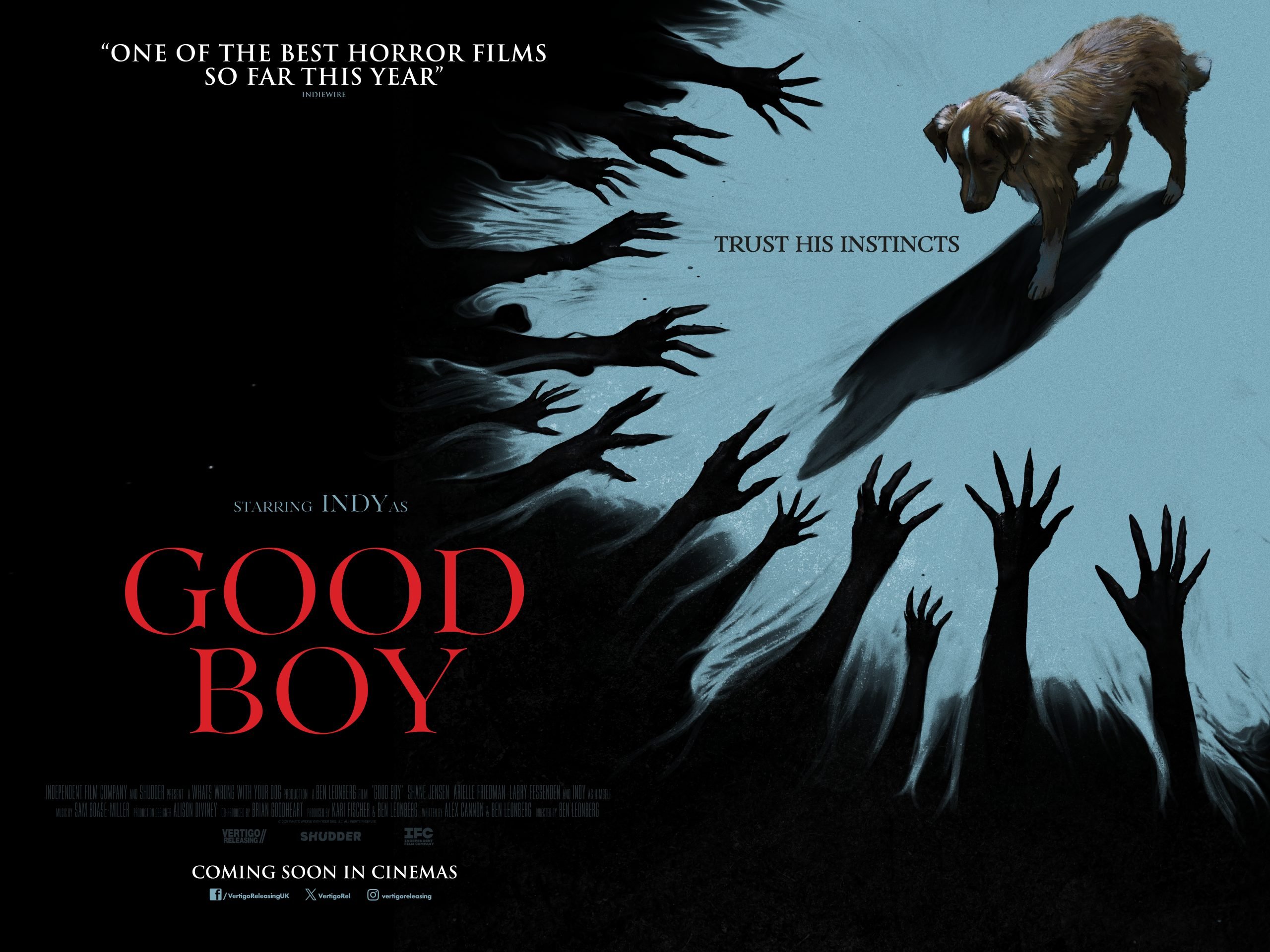
 Good Boy works wonders with its bi-level approach to horror, metaphorically reframing illness as a fiendish monster and literally reframing how we experience said monster by putting us at dog’s-eye view. Everything falls apart*, as our eponymously credited canine hero Indy sees in a very short amount of time as he accompanies his beloved companion Todd (Shane Jensen) to his grandfather’s remote cabin in the woods, relocating to quietly deal with a long illness. But this illness isn’t going quietly, and Good Boy puts us right alongside Indy as he sees ghastly things in the night as Todd’s illness threatens to overcome him.
Director and co-writer Ben Leonberg takes a loving, novel approach to his and co-writer Alex Cannon’s story about this creeping death that stalks Todd relentlessly by asking us to witness these events through Indy’s eyes. For much of the film, cinematographer Wade Grebnoel places us right over Indy’s shoulder, which gives us an exciting perspective on what’s happening in both the real world and the nighttime world, where Todd starts to lose touch with reality and a dark creature begins to visit. The caring Indy stays right by Todd’s side and keeps faithful watch, whether it’s while Todd’s sleeping or when they’re out in the woods, running into weird neighbor Richard (Stuart Rudin), who warns them of various traps he’s laid for foxes.
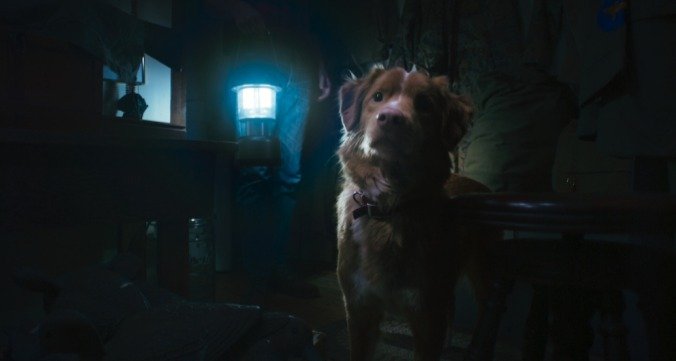 It’s of note that Leonberg has used no CGI to enhance Indy’s performance; every reaction Indy has is natural, and—like Indy himself—we don’t quite know what he’s seeing, but this film relies on his reassuring presence, and Indy definitely gives that to us and Leonberg. We’re given a lot to chew on, as far as what Indy’s experiencing. Is this all real, or is there some kind of supernatural activity afoot? Is the nightly visiting specter Death itself? Could it possibly be Todd’s scent making Indy look at Todd as a monster? Is it Todd’s family history, as seen in videos featuring his grandfather suffering the same illness, sliding into mental and physical decline while also maintaining a friendship with a dog?
Good Boy asks us to consider these questions while drawing us into a dark house where this creature hides in the shadows. It doesn’t help that the power lines are so bad that Todd has to rely on a borrowed generator, thus making the comfort of illumination an irregular savior. Circumstances help cede ground to the nightmarish approach of this figurative manifestation of Todd’s disease, a figure that Indy tries to fight to defend Todd while he’s asleep. People with dogs sometimes wonder what the hell our friends are barking at randomly; Leonberg gives us the possibility that there might be something we humans cannot see, and they’re just trying to alert us, casting new light on this universal occurrence.
 As the majority of Good Boy is shot at Indy’s level, we rarely see human faces enter the frame; mostly, they’re shot from afar or semi-obscured, such as a sequence where Indy witnesses Todd seemingly harming himself in his sleep. This particular event is set up as a typical “noise downstairs” bit, complete with shadowy figures walking back and forth across the lens before coming to the truth of the scene. Much of Good Boy is couched in this curious state where we don’t know if it’s Todd’s illness or the monster causing all the havoc. Or maybe they’re one and the same.
We’re given just a little less than what we want to be absolutely sure of what’s going on, but Good Boy still remains compelling and suspenseful. The film establishes that Indy (and, before him, Todd’s grandfather’s dog, Bandit) might be the only thing standing in the way of the dark figure stalking throughout the house. So we hang on every look Indy gives to the sides, staring into black corners and corridors, waiting for something to jump out at us. Our hopes and sympathies lie with Indy’s every move to protect Todd, and Ben Leonberg—Indy’s real-life companion—captures him with love, gaining a canine performance that defies description and expectation. Good Boy’s central narrative may straddle both sides of the dividing line between the corporeal and supernatural, but it almost doesn’t matter; what matters is that this “man’s best friend” truly defines the meaning of that title.
* I’m so sorry. I couldn’t resist. Apologies to Peter Stuart and the band.
