
 Five years separate us from Todd Phillips’ startling Joker and a return to Gotham City in Joker: Folie à Deux. In the film’s world, only two years have passed since Arthur Fleck’s (Joaquin Phoenix) first and only appearance on Murray Franklin’s (Robert De Niro) late-night show, a night that ended in Arthur’s imprisonment and full descent into mania. As far as matching the tone of the first film, no time has passed at all; we are watching the second half of a detailed examination of Arthur’s psyche and motives that jumps right back to the grimy, icky feel of Joker.
It helps, of course, that Phillips is working with largely the same creative team responsible for Joker’s look and machinations. Thematically and visually, Joker: Folie à Deux appears cut from the same cloth as its predecessor; color palettes, shading, music choices, and Lawrence Sher’s immersive photography and long takes capture our dive into this dismal city, far removed from its former glory and buried in sickly tones devoid of life or spirit. It’s here where we find Arthur firmly ensconced in Arkham State Hospital, lorded over by contemptible prison guards who hustle him from his room to his meetings with lawyer Maryanne Stewart (Catherine Keener) for his upcoming murder trial, angling for an insanity defense.
Once again, Joaquin Phoenix transforms himself into the ghastly undernourished and mentally damaged Arthur Fleck. His clothes hang off his barely-there frame; his gauntness also makes his facial expressions disturbingly frightening and effective. But even more of a transformation is what’s behind Arthur’s eyes, grimacing smiles, and demented fits of laughter. With Arthur’s sanity and competence to stand trial in question, Phoenix pulls one of cinema’s greatest magic tricks on us by ambiguously playing Arthur as crazy or sane in any given moment, and with the addition of the script throwing in dream sequences that allow us to see into Arthur’s perceptions, we’re never sure what’s truth or merely figments of his imagination.
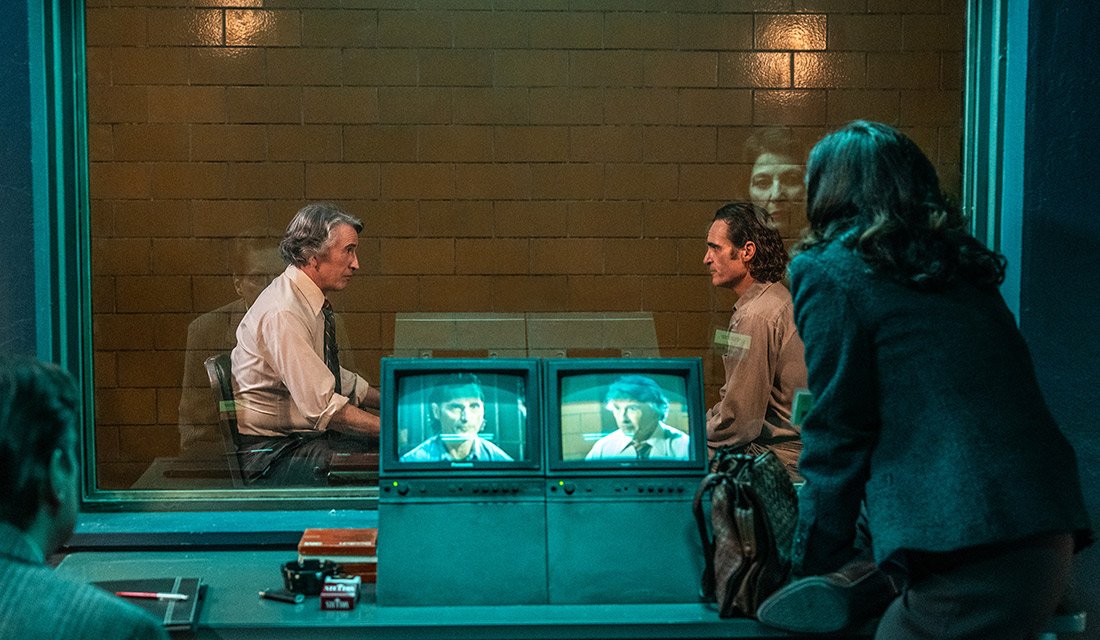 Joker toyed with us this way, but this time, Phillips takes us all the way into Arthur’s mind, where… wait a second.
Let’s start with the idiom “marching to the beat of his own drum.” We’ve all heard that phrase used to describe someone who behaves differently, implying that the person doesn’t hear the same music we’re all hearing. Phillips and returning co-writer Scott Silver take this notion and manifest it in Arthur’s abnormality, literally taking us on a journey through the music in his head, which translates to singing and dancing to his own tunes. He’s not in sync with the rest of the world… at least until Lee Quinzel (Lady Gaga) is seen through a doorway singing “Get Happy” with her therapy group while Arthur’s escorted to talk with Maryanne.
Saturated colors and swelling orchestrations abound when he lays eyes on Lee, and it’s only a matter of time before they take hesitant steps toward each other. It’s interesting to see them going from singing in counterpoint to full-on montages of them belting showtunes in unison. For Arthur, it’s the possibility of love or a friendship that doesn’t have to do with sucking up to the guards in exchange for cigarettes; for Lee, however, it’s getting close to this electrifying anarchist and jumping on for the ride. She’s enamored with the fantasy the Joker represents, not the battered Arthur, who, in his desperation, sees Lee as someone who understands him.
Lady Gaga mines a stunning depth with which she layers her character, and Phillips slowly peels away at her until we’re told her full story. Even then, Gaga uses every bit of her screentime to define Lee as someone who’s just so slightly out of Arthur’s reach, no matter how intimate they become. It’s like their hands are so close to touching and forming an inseparable bond, but there’s something razor-thin keeping them apart. This isn’t a proximity or physical problem; the film makes it plain to see that they touch each other enough. But it’s like she’s one millisecond removed from being in the same figurative space and time he occupies, a dichotomy on which this movie thrives.
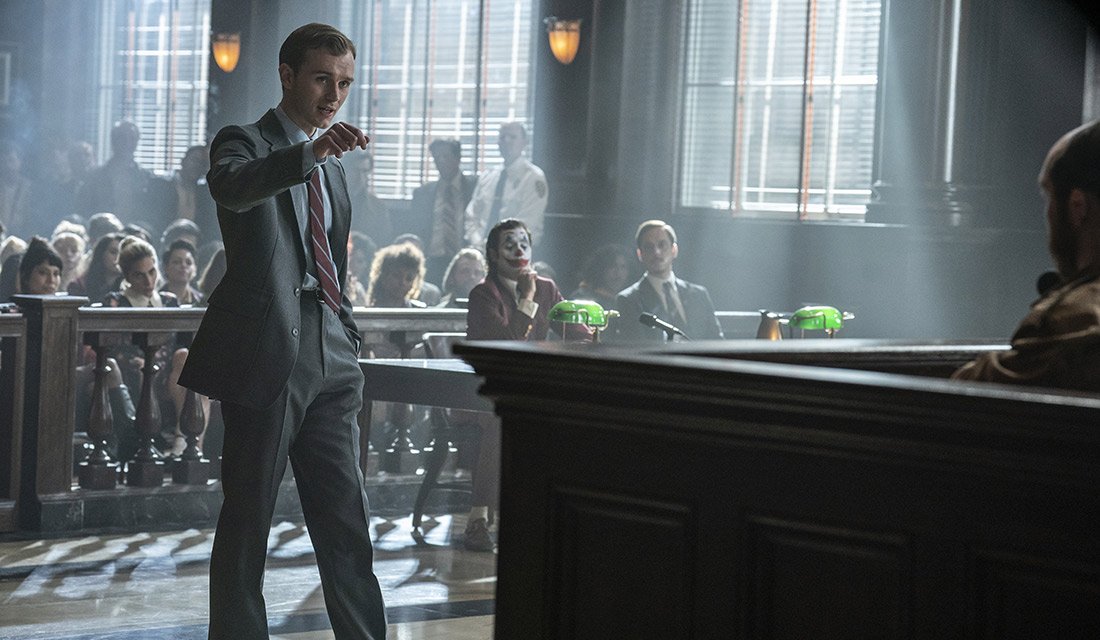 One issue with this film is that Arthur has nothing to do with Bruce Wayne or the Batman comics; this Joker’s just some guy who got the shit end of the stick and, through a series of unfortunate events, somehow made a name for himself. The name “Joker” is merely a contrivance, a dismissive label slapped on him by someone who didn’t bother to understand him in the first movie. Thus, Joker: Folie à Deux comes off more as performance art than anything that actually has to do with comic book lore. The scripts for both of these films could have all the comic references taken out of them and still stand on their own, as they’re only using the Joker name as a scapegoat, a face to put on crime and society’s ills. No one’s asking for Marvel hijinks; this film is a completely different animal, which I accept and appreciate. But nothing – aside from the greasepaint and uncontrollable laughter – warrants the need for Joker. (But eagle-eyed viewers might catch some background action in a very pivotal, consequential shot that might mean… something.)
In the same vein as its predecessor, Joker: Folie à Deux posits how the world would treat someone like Arthur/the Joker, himself a product of abuse and lies. There’s no one being dropped into a vat of toxic waste at Axis Chemicals or establishing himself as Gotham’s criminal mastermind. Phillips and Silver further their last film’s statements about the lack of proper mental care, again centering Arthur as a victim of the erosion of public health services. They also take to task the cult of personality that forms around notoriety and corruption, a phenomenon that seems almost entirely endemic to America. Oliver Stone almost preternaturally examined our true crime obsession with the fanaticism we see in Natural Born Killers; here, the sign-holding masses are hung up on the Joker, someone who committed six murders and is facing the death penalty. However, Phillips isn’t aiming to glorify senseless murder; what he’s hoping to do here is to ask us to empathize with a broken man dealt a losing hand and pushed to extremes. And he isn’t even that extreme – he’s merely playing a part, acting how he thinks others want him to act.
The teeming masses outside his trial only see him as a figurehead for anarchy who’s taking it to The Man; that’s not who he is, but he thinks he’s finally gaining some form of acceptance. When he takes command of his defense and cross-examines a witness, he puts on some strange Foghorn Leghorn-esque accent picked up from any one of countless television courtroom dramas. What becomes evident is that he has no life of his own, no sense of self; Arthur is an empty shell, but he’s still trying to live up to his mother’s hope for him to make others happy. The trouble is that he doesn’t know what makes him happy, much less how to go about attaining happiness.
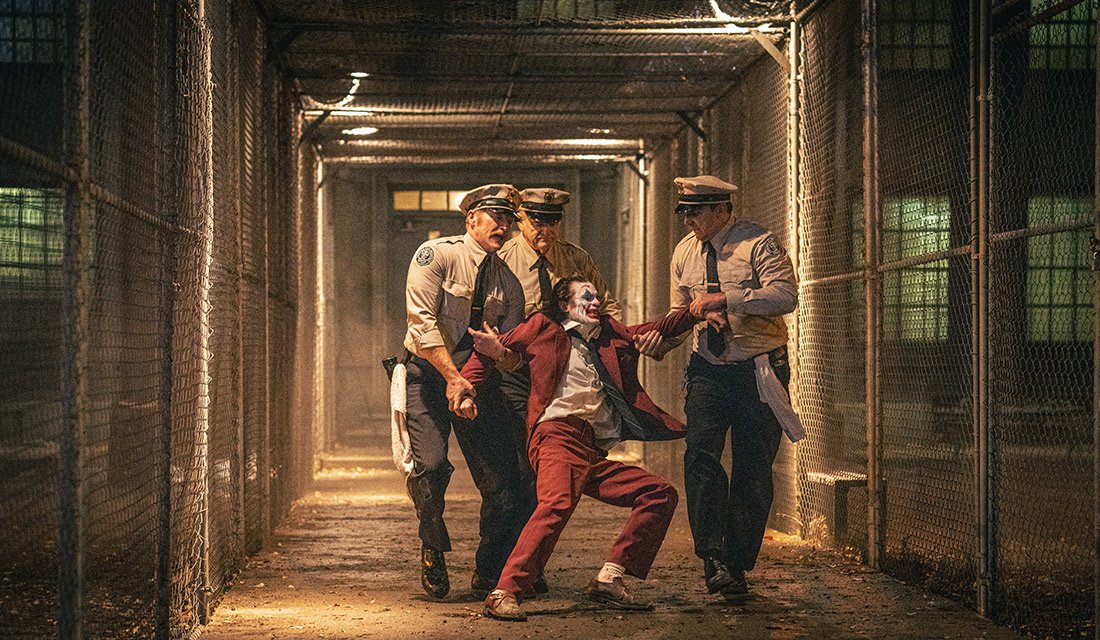 From this perspective, Joker: Folie à Deux is the second half of a story about a nobody suddenly thrust into the spotlight who doesn’t know how to handle any of it. Todd Phillips succeeds in returning us to the darkness of Arthur’s soul and putting us in this destroyed man’s shoes; we pity Arthur for being well out of touch, but at the same time, we also find ourselves wondering what this film’s purpose is. Dreamlike musical diversions balance overt social commentary to show us the swings Arthur suffers, and the production is top-notch, but at its heart, Phillips wants us to watch a man drowning in misery and an abhorrent lack of any kind of compassion. And when we do get a small bit of compassion, it’s fraught with regret and fear. There is nothing uplifting about Joker: Folie à Deux; there is only Arthur in pain and distress, with no one reaching out a genuine hand to help or guide him toward the light. Much like Joker, the performances and filmmaking are powerful, but I’d be loath to revisit these dystopian visions of Gotham City.
